After the Breakthrough: Why We Still Need Iyanla and Why Inside the Fix Matters Now
– 4 min read


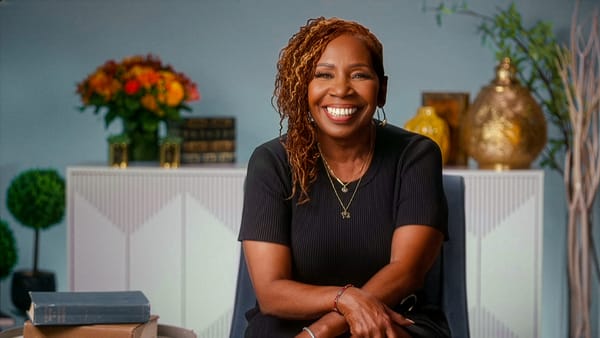
Iyanla Vanzant returning to television with ‘Inside the Fox’ feels less like a re-boot, and more like a cultural intervention. In a moment defined by emotional fragmentation, overdiagnosis, and performative healing, Iyanla’s return arrives not as nostalgia, but as necessity.
I sat down with Iyanla this week with a sense of genuine anticipation—not only as a journalist, but as someone whose life was once touched by Iyanla: Fix My Life. Years ago, when I appeared on the show, I understood that the experience was never truly about me. I was the example. The open channel. The story through which she reached countless women who, like me at the time, had learned to bury fear, vulnerability, and femininity beneath ambition and professional success. Work became armor. Achievement became refuge. Emotional exposure felt unsafe. What surprised me most during our recent conversation was not how much I had grown, but how much she had.
In the nearly five years since Fix My Life went off the air, Iyanla has lived deeply. She has endured the devastating loss of one of her daughters. She has navigated the same global rupture we all experienced during the pandemic. She spoke openly about how those experiences reshaped her, reminding me that wisdom is not static—it evolves. “You should always be learning,” she told me, not as a platitude, but as a principle. That evolution is precisely what gives Inside the Fix its urgency.
The new series revisits some of the most impactful episodes of Fix My Life, but it does not merely replay moments of pain. Instead, it provides what our culture rarely allows space for: reflection, accountability, and continuation. Inside the Fix asks the question therapy culture often avoids—what happens after the breakthrough?
I asked Iyanla whether she felt this return was timely, particularly given the erosion of human connection we’ve witnessed in recent years. Romantic relationships feel increasingly fragile. Families are fracturing. And most concerning, we are seeing a growing trend of people claiming to “divorce” their parents, cutting off entire bloodlines under the banner of self-care.
“There is no way for a child to divorce a parent,” she said. “You can try, but their blood runs through your veins. It is an act of self-betrayal.”
She was careful to clarify that she is not opposed to boundaries—quite the opposite. But she drew a sharp distinction between boundaries and abandonment, one many people have blurred.
“There is a difference between setting a boundary and putting up a wall,” Iyanla explained. “Boundaries aren’t judgmental. In many instances, the children are judging the parents.”
In her view, the language of healing has been distorted into a language of moral superiority. Psychiatric and therapeutic terms—narcissist, trauma bond, gaslighting—are now deployed casually, often by people with no clinical training, to diagnose and dismiss rather than understand. “It’s dangerous,” she said plainly, to use language we do not fully comprehend to justify emotional avoidance.
Iyanla is clear-eyed about the necessity of self-protection. When boundaries are consistently violated, individuals have the right to determine how—or if—communication continues.
“If the parent refuses to honor the boundary,” she said, “you do have the right to choose how the communication moves forward. It could be through calls, or text, or even not at all.”
But even then, she offered a warning that cuts deeper than cancellation culture ever could.
“If you choose no contact,” she added, “do not be surprised when that DNA rises up within you wanting to be recognized.”
It was a reminder that healing does not come from erasure. Biology, lineage, and identity cannot simply be blocked or unfollowed. What is denied externally often resurfaces internally, asking to be acknowledged in quieter, more complicated ways.
Iyanla sees the same breakdown in romantic relationships. We are no longer listening to one another. We speak to be heard, not to understand. We shout across social media instead of sitting with discomfort. In that noise, intimacy collapses.
This is where she introduced one of the most resonant ideas of our conversation: spiritual hygiene.
We brush our teeth daily. We wash our faces without question. Yet few of us check our emotional, spiritual, and mental well-being with the same discipline. Healing, Iyanla insists, is not an event—it is maintenance. Neglecting the inner self is no different than neglecting the body.
What makes Iyanla Vanzant singular is not her ability to identify pain, but her gift for tracing it back to its root and guiding people through it without spectacle. She is not therapy as entertainment; she is therapy as cultural service. She understands how personal wounds intersect with generational trauma, social conditioning, and spiritual neglect—and she refuses to let people bypass themselves in the process.
Inside the Fix offers the ellipses—the unseen chapters that follow revelation. Because healing does not end with awareness. It begins there. Growth happens after the tears, after the confrontation, after the cameras stop rolling.
Iyanla’s return is not about fixing us. It is about reminding us that transformation is ongoing, that wisdom deepens through lived experience, and that healing requires participation.
After the breakthrough, then what? ‘Inside the Fix’ airs Saturdays at 8 p.m. on the OWN network. At a time when connection feels increasingly fragile, Iyanla Vanzant remains one of the few voices brave enough, and loving enough to guide us back to ourselves.